News
Quimbaya Gold Completes Tahami Center Exploration Targets; Cu-Mo-Au Porphyry System Confirmed Ahead of Q2 Drill Testing
May 6, 2026
DownloadGeophysics, surface geochemistry, and underground channel sampling independently confirm Cu-Mo-Au porphyry corridor; preserved lithocap and up to 2.14% CuEq
Vancouver, British Columbia–(Newsfile Corp. – May 6, 2026) – Quimbaya Gold Inc. (CSE: QIM) (OTCQX: QIMGF) (FSE: K05) (“Quimbaya” or the “Company”) has completed its integrated pre-drill program at Tahami Center, Segovia, Colombia. Building on the previously announced 3.1-kilometer magnetic anomaly (March 2, 2026), three additional independent datasets – radiometric survey, soil geochemistry, and underground/surface channel sampling – consistently define the same large-scale Cu-Mo-Au porphyry target. Initial drill testing of the system is planned for Q2 2026.
Highlights
- Channel sampling: 0.8m @ 1.82% Cu, 1,047 ppm Mo (2.14% CuEq) at surface, within a broader 1.35m composite at 0.53% CuEq
- 2.4 × 1.3 km Cu-Mo-Au corridor, larger than the footprint independently confirmed by Dr. Redwood, Cu-Mo-Au core flanked by classic Pb-Zn halos across 3+ km of open strike: textbook porphyry geometry
- Geophysics and geochemistry align perfectly – stacked on top of each other, two independent datasets pointing to the same target; fault corridors control mineralization along 3+ km of open strike
- The system is intact: surface mineralogy confirms the porphyry lithocap is preserved, the core is below, and the drill has a clean, de-risked target
“We did our homework. Four independent datasets — geophysics, radiometrics, geochemistry, and channel sampling — return one consistent answer: a large, intact Cu-Mo-Au porphyry system with a defined drill target. Tahami Center is ready.”
Alexandre P. Boivin, CEO of Quimbaya Gold
Completed Exploration Datasets
Surface Geochemistry – Soil Sampling
A 276-sample ridge-and-spur soil program at 100-meter spacing across 400 hectares outlines a coherent 2.4 × 1.3 km Cu-Mo-Au corridor (up to 930.90 ppm Cu, 77 ppm Mo), expanding the system footprint beyond the 2.0 × 1.4 km extent documented by Dr. Redwood in November 2025. Lead and zinc form a distal peripheral halo along the same trend — textbook porphyry metal zonation. Gold values up to 387 ppb Au; gold concentrations in porphyry systems typically increase with depth toward the potassic core, which drill testing will target.
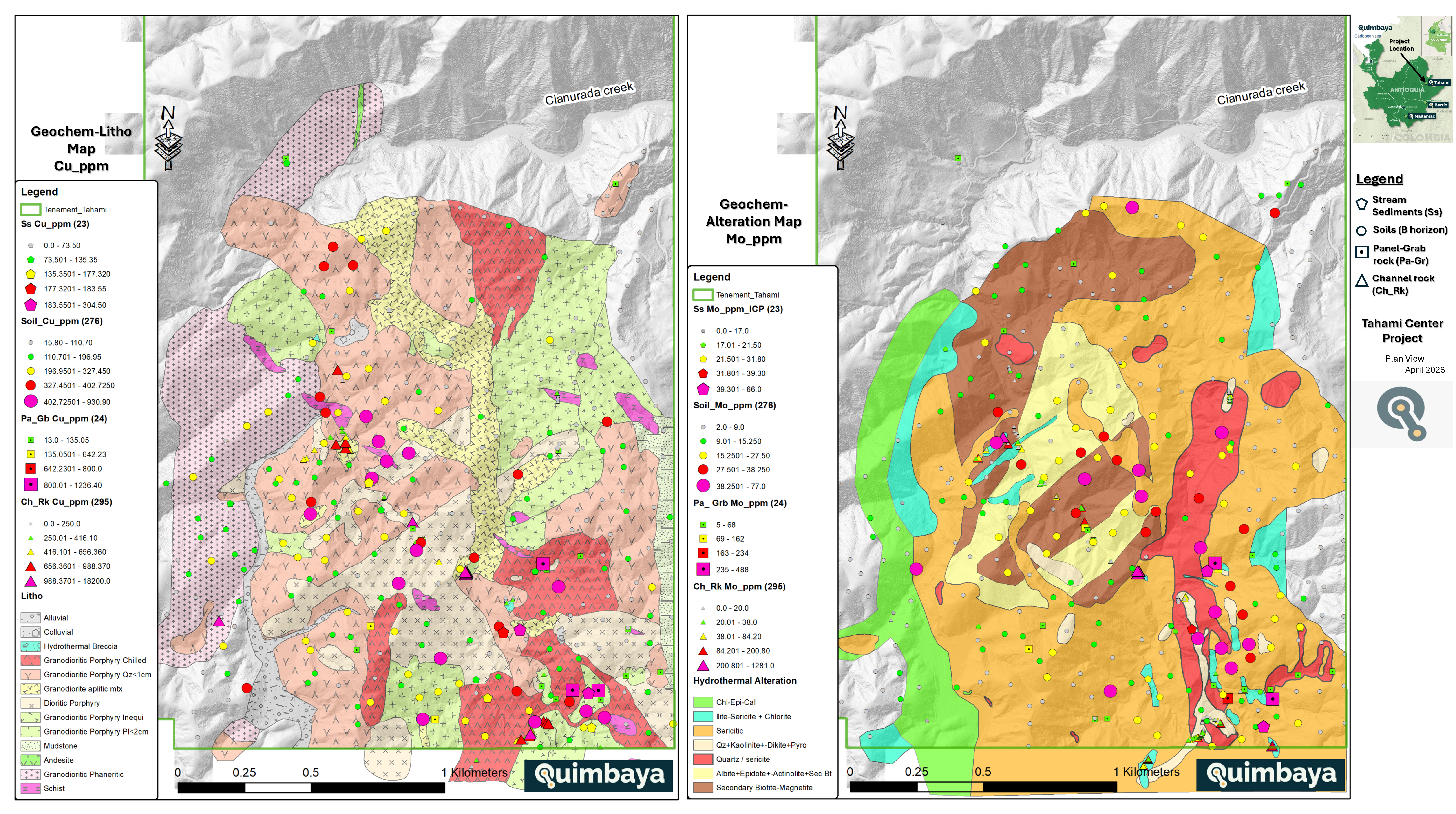
Figure 1. Plan view of the Tahami Center Project showing Lithology map / copper (left) values, and hydrothermal alteration map / molybdenum (right) geochem values, rock and stream sediments geochemistry anomalies associated with the porphyry Cu-Mo-Au system. Dashed line outlines interpreted mineralised corridor.
To view an enhanced version of this graphic, please visit:
https://images.newsfilecorp.com/files/11347/295963_litho_alteration_cu_ppm_mo_ppm_all2.png
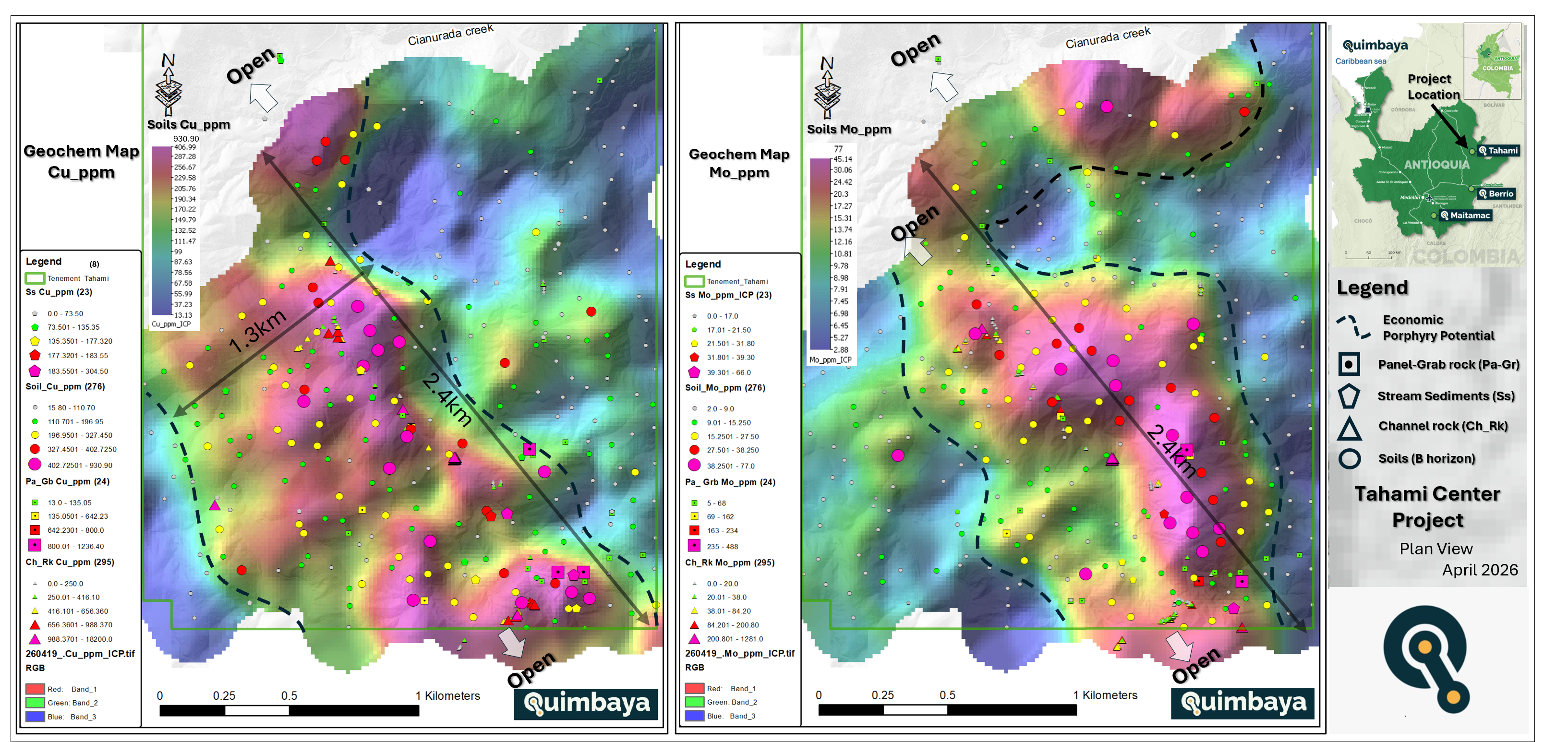
Figure 2. Plan view — Cu and Mo soil geochemistry, Tahami Center. Coherent 2.4 × 1.3 km NW-SE corridor. System open in all directions.
To view an enhanced version of this graphic, please visit:
https://images.newsfilecorp.com/files/11347/295963_260419_cu_mo.png
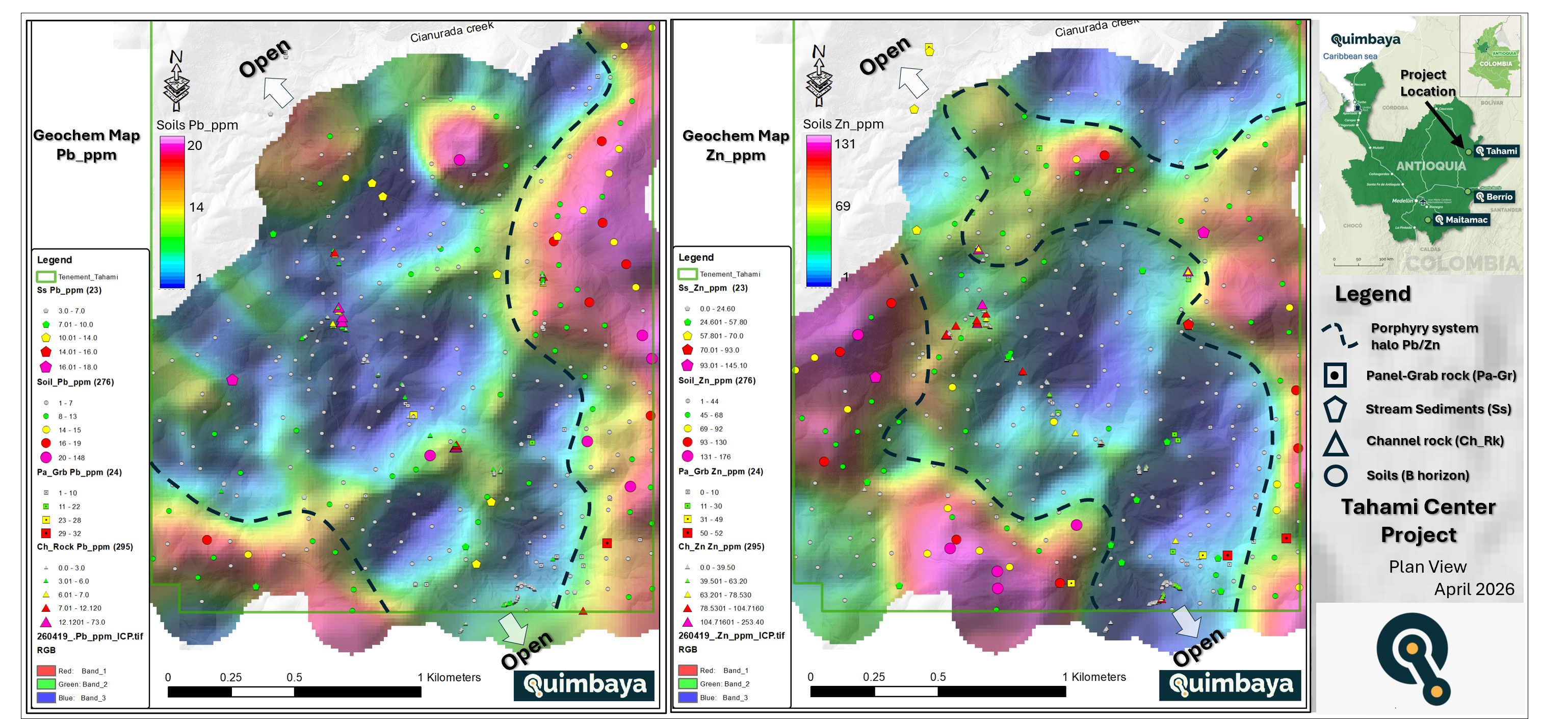
Figure 3. Plan view — Pb and Zn peripheral halos, Tahami Center. Distal Pb-Zn signature surrounding the Cu-Mo core is characteristic of classical porphyry metal zonation.
To view an enhanced version of this graphic, please visit:
https://images.newsfilecorp.com/files/11347/295963_260419_pb_zn.png
Channel Sampling – El Diamante Mine and surface outcrops
Channel sampling within the El Diamante artisanal workings and surface outcrops confirms Cu-Mo mineralization directly beneath the surface anomalies. A total of 95 composited intercepts were generated across 45.3 meters of sampled strike. A top-cut of 0.64% Cu was applied to high-grade outliers. Channel intervals are measured along exposed workings and may not represent true widths.
| Channel | Length (m) |
Cu (%) |
Mo (ppm) |
CuEq (%)* |
Best Sub-interval |
| CH_4132 | 1.35 | 0.391 | 438 | 0.525 | 0.8m @ 1.82% Cu, 1,047 ppm Mo (2.14% CuEq) |
| CH_4134 | 0.90 | 0.303 | 332 | 0.404 | 0.4m @ 0.65% Cu, 1,281 ppm Mo (1.04% CuEq) |
| CH_4133 | 1.06 | 0.356 | 82 | 0.381 | 0.56m @ 1.53% Cu, 127 ppm Mo (1.57% CuEq) |
| CH_5035 | 1.40 | 0.292 | 57 | 0.309 | 0.6m @ 0.83% Cu, 110 ppm Mo (0.86% CuEq) |
| CH_5033 | 7.40 | 0.134 | 352 | 0.241 | 0.5m @ 0.92% Cu, 674 ppm Mo (1.13% CuEq) |
| CH_5036 | 3.40 | 0.172 | 123 | 0.210 | 0.7m @ 0.84% Cu, 429 ppm Mo (0.97% CuEq) |
| CH_0303 | 2.10 | 0.123 | 301 | 0.215 | 0.7m @ 0.29% Cu, 565 ppm Mo (0.46% CuEq) |
| CH_4131 | 1.15 | 0.108 | 242 | 0.182 | 0.65m @ 0.144% Cu, 346 ppm Mo (0.25% CuEq) |
Table 1. *CuEq (%) = Cu (%) + Mo (%) × 3.059 | Cu US$4.25/lb, Mo US$13.00/lb | Equal recoveries assumed pending metallurgical testing. For illustrative purposes only.
Airborne Geophysics
Radiometric processing of the GeoScan Ingeniería S.A.S. survey (1,000 ha, 116 line-km) identifies potassium enrichment zones overlapping the 3.1-kilometer high magnetic corridor at depth — consistent with potassic alteration where Cu-Mo-Au concentrates in porphyry systems. Structural analysis defines a dominant NW-SE fault network interpreted to have controlled mineralization emplacement across the corridor.
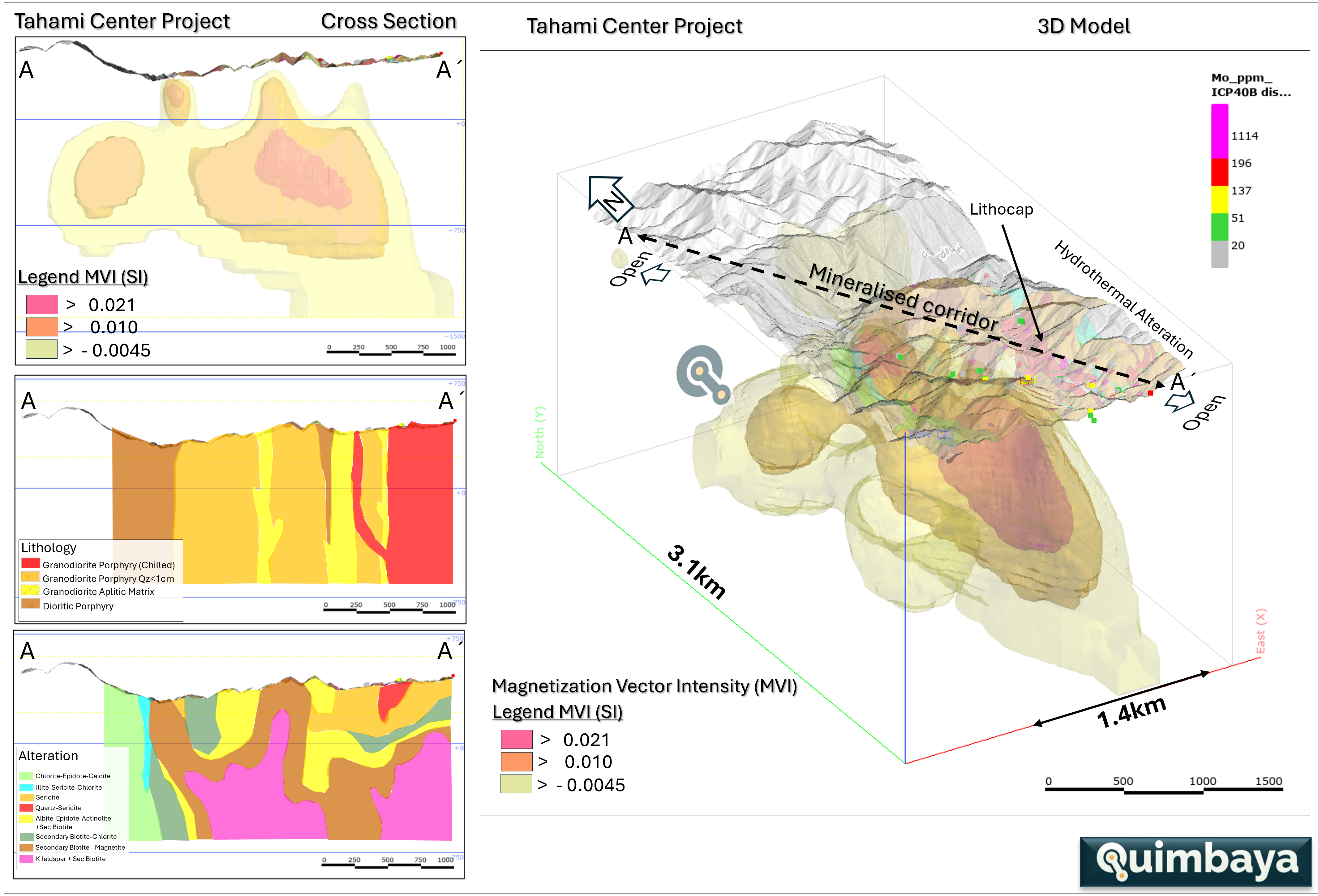
Figure 4. 3D Magnetizaction Vector Intensitity model vs hydrothermal alteration map with the dashed line outlines interpreted mineralised corridor (right). Cross sections of the MVI, Lithology and alteration (left).
To view an enhanced version of this graphic, please visit:
https://images.newsfilecorp.com/files/11347/295963_mvi_alt7.png
“Field observations confirm a porphyry copper system — a first for the Segovia district. An analogy can be made with the great Cu-Mo deposits of southern Peru: Toquepala, Cuajone, and Quellaveco, formed on the same continental magmatic arc — exactly what we are seeing at Tahami Center.”
— Dr. Stewart D. Redwood, BSc (Hons), PhD, FIMMM, FGS | Field examination November 2025
Next Steps
Initial drill testing of the Tahami Center porphyry system is planned for Q2 2026, targeting the convergence of the magnetic, radiometric, and geochemical anomalies at approximately 200 – 400 meters depth. A separate announcement will follow upon commencement of drilling.
Sample preparation and QA/QC analysis
All samples were prepared and analyzed by SGS laboratories in Medellín, Colombia, and Lima, Peru. SGS Colombia and SGS Peru are ISO 17025-accredited and are independent of the Company. Gold assays were completed using fire assay methods, with multi-element analysis conducted using ICP techniques. Gold was determined by fire assay on a [30] g charge with an atomic absorption finish (SGS method code FAA313); multi-element analysis was conducted by four-acid digestion with ICP-AES/ICP-MS finish (SGS method code ICP40B). Over-range copper assays above the upper detection limit of 1% Cu were re-analysed by ore-grade assay methods (SGS code AAS41B). Detection limits for the primary elements were Cu 0.5 ppm, Mo 1 ppm, Au 5 ppb, Pb 2 ppm, and Zn 0.5 ppm. The analytical protocols used are industry-standard for porphyry-style mineralisation and are considered appropriate for the style and grade of the samples collected.
Quimbaya implemented a quality assurance and quality control (QA/QC) program that included the regular insertion of certified reference materials, blanks, and field duplicates. Control samples were inserted at an approximate rate of 15-20% throughout the sampling program. QA/QC results were reviewed by the Company’s Qualified Person and are considered acceptable, supporting the reliability of the analytical data. Certified reference materials (CRMs) used included PORF43, PORF44, PORF35 if target rock certificates covering the expected grade range for Cu, Mo, and Au. CRMs returned values within ±2 standard deviations of their certified means. Coarse blank material sourced from Bureau Veritas quartz certificates returned values below 10x detection limit] for all elements of interest. Field duplicates showed an average pair correlation of 91% for Cu and 83% for Au, within industry-accepted tolerances.
Channel samples were collected as continuous chip channels cut perpendicular to the observed structural orientation within underground workings at the El Diamante mine and surface outcrops. Channel dimensions were approximately 15 cm wide by 2m long. Sample intervals reported in Table 2 represent sample lengths along the channel; the orientation of mineralization relative to channel direction has not yet been independently determined, and reported intervals are therefore not representative of true width. Because the channels were cut within active artisanal workings, which preferentially target higher-grade material, the results in Table 2 should not be interpreted as representative of average mineralization grade across the broader system. Selection of composited intervals reported in Table 2 was based on a 0.642% Capping with an average composite of 2m internal dilution and a minimum composite length of 0.5 m. Full channel sample results will be disclosed in a subsequent technical report.
Qualified Person
Ricardo Sierra, AusIMM, is a non-independent Officer “VP Exploration” and the Qualified Person for this news release. The scientific and technical content of this press release has been reviewed and approved by Mr. Sierra, who has sufficient experience with South American exploration projects relevant to the style of mineralization and type of deposit under consideration. He consents to the inclusion of the Exploration Results in the form and context in which they appear.
About Quimbaya
Quimbaya Gold is a Colombia-focused exploration company advancing a district-scale portfolio of more than 73,000 hectares across highly prospective mineral belts in Antioquia, Colombia. Its flagship Tahami Project, located in Segovia, is immediately adjacent to Colombia’s most prolific high-grade gold mining camp, while the Berrio and Maitamac projects are strategically positioned in Puerto Berrío and Abejorral, respectively. Early-stage exploration has identified extensive mineralized vein systems and documented features consistent with a large, multi-commodity porphyry system prospective for gold, copper and molybdenum, highlighting the district-scale discovery potential of Quimbaya’s land package. The Company is led by a proven technical and management team committed to disciplined exploration and responsible mining practices.
Contact Information
Alexandre P. Boivin, President and CEO apboivin@quimbayagold.com
Sebastian Wahl, VP Corporate Development swahl@quimbayagold.com
Quimbaya Gold Inc.
Follow on X @quimbayagoldinc
Follow on LinkedIn @quimbayagold
Follow on YouTube @quimbayagoldinc
Follow on Instagram @quimbayagoldinc
Follow on Facebook @quimbayagoldinc
Cautionary Statement Regarding Forward-Looking Information
This news release contains “forward-looking information” and “forward-looking statements” (collectively, “forward-looking statements”) within the meaning of applicable Canadian securities legislation. All statements, other than statements of historical fact, contained in this news release constitute forward-looking statements. Forward-looking statements are frequently identified by words such as “plans,” “planned,” “expects,” “intends,” “anticipates,” “believes,” “estimates,” “forecasts,” “projects,” “targets,” “potential,” “may,” “will,” “should,” “would,” “could,” “continues,” “ongoing,” “pending,” “scheduled,” “upcoming,” and similar expressions, or the negative thereof.
Forward-looking statements in this news release may include, but are not limited to, statements and information regarding: the Company’s business strategy, plans, and outlook; the exploration and development plans, activities, and results for the Company’s mineral properties in Colombia, including the Tahami Project (comprising the Tahami South and Tahami Center targets), the Berrio Project, and the Maitamac Project; the timing, design, scope, costs, and results of drill programs, geochemical and geophysical surveys, mapping, sampling, metallurgical testwork, and other exploration and technical activities; the interpretation of geological, geophysical, geochemical, and sampling data, including the nature, scale, continuity, and prospectivity of mineralized systems identified on the Company’s properties; the potential discovery, expansion, delineation, or future estimation of mineral resources or mineral reserves; the anticipated timing, structure, and results of planned financings, warrant exercises, and other capital markets activities, and the use of proceeds therefrom; the receipt, timing, and scope of required permits, licences, environmental approvals, and regulatory and stock-exchange approvals; the negotiation, execution, completion, and integration of acquisitions, dispositions, joint ventures, option agreements, and other strategic transactions; the Company’s ability to achieve its budget, exploration, and corporate objectives; the outlook for metal prices and demand in the commodities relevant to the Company; and future financial performance.
Forward-looking statements are based on a number of material factors and assumptions, including, but not limited to: that the Company’s exploration, technical, and operational activities will proceed substantially as planned and on the timelines anticipated; that the Company will have sufficient access to capital and financing on acceptable terms to fund its business plan; that the Company will obtain and maintain, in a timely manner, all required permits, licences, environmental approvals, and regulatory and stock-exchange approvals; that the Company will maintain favourable relationships with local communities, landholders, indigenous groups, and other stakeholders; that drill rigs, qualified personnel, laboratory services, equipment, materials, and other inputs will remain available on commercially reasonable terms; that currency exchange rates, metal prices, energy costs, and other macroeconomic factors will remain broadly consistent with current expectations; that the geological, geochemical, geophysical, and sampling interpretations relied upon by the Company, including those of third-party experts, accurately reflect subsurface conditions; that the Company’s mineral properties are not subject to any undisclosed material title, environmental, or other encumbrance; that there will be no material adverse change in the political, economic, legal, security, or social environment in Colombia; and that counterparties to the Company’s agreements will perform their obligations in accordance with their terms.
Forward-looking statements are subject to known and unknown risks, uncertainties, and other factors that may cause the actual results, performance, or achievements of the Company to differ materially from those expressed or implied by such forward-looking statements. Such risks include, but are not limited to: risks inherent in mineral exploration, including that exploration results may be poorer than anticipated, that drilling may not intersect mineralization as expected, and that assay or sampling results may not support previously disclosed geological interpretations; fluctuations in metal prices, currency exchange rates, interest rates, and general capital market conditions; the Company’s ability to finance its exploration, operating, and corporate activities on acceptable terms; delays in or failure to obtain required permits, licences, or regulatory or stock-exchange approvals; changes to applicable laws, regulations, taxation policies, and governmental policies; risks associated with operating in Colombia, including security, political, governance, regulatory, community, social-licence, and socio-economic risks, and risks associated with artisanal and informal mining activity on or adjacent to the Company’s properties; environmental risks, including compliance obligations and the availability of water, power, and infrastructure; risks related to the accuracy of the Company’s geological interpretations, geochemical and geophysical data, sample results, and other technical information; title and tenure risks; competition for mineral properties and for qualified personnel; reliance on key personnel, consultants, and third-party contractors; risks associated with acquisitions, dispositions, joint ventures, and option agreements, including failure to complete announced transactions or failure to realize anticipated benefits; health, safety, and pandemic-related risks; risks related to the Company’s continued listing on the Canadian Securities Exchange and other markets on which its securities trade; and other risks described in the Company’s continuous disclosure filings available under the Company’s profile on SEDAR+ at www.sedarplus.ca.
Readers are cautioned that the foregoing lists of material factors, assumptions, and risk factors are not exhaustive. Forward-looking statements contained in this news release are made as of the date of this news release, are expressly qualified in their entirety by this cautionary statement, and represent the Company’s expectations as of such date. Although the Company believes that the assumptions and expectations reflected in such forward-looking statements are reasonable, there can be no assurance that such forward-looking statements will prove to be accurate or that underlying assumptions will be correct, and actual results and future events could differ materially from those anticipated. Accordingly, readers are cautioned not to place undue reliance on forward-looking statements. Except as required by applicable securities laws, the Company undertakes no obligation to publicly update or revise any forward-looking statement, whether as a result of new information, future events, or otherwise.
Cautionary Note Regarding Exploration Results and Mineralization
The scientific and technical disclosure in this news release has been prepared in accordance with the Canadian regulatory requirements set out in National Instrument 43-101 – Standards of Disclosure for Mineral Projects (“NI 43-101”) and the Canadian Institute of Mining, Metallurgy and Petroleum (CIM) Definition Standards for Mineral Resources and Mineral Reserves adopted by CIM Council on May 10, 2014. Exploration results disclosed in this news release, including soil, rock, channel, and drill sampling results, do not constitute a mineral resource or a mineral reserve as defined under NI 43-101 and the CIM Definition Standards, and readers should not assume that any mineralization disclosed herein will ever be delineated as a mineral resource or a mineral reserve. Sample lengths and intercepts reported in this news release represent the interval measured in the drill hole, channel, or along the sampled surface, and do not necessarily represent the true width of mineralization. There is no certainty that further exploration will result in the discovery or definition of a mineral resource or a mineral reserve on any of the Company’s mineral properties.
NOT FOR DISTRIBUTION TO UNITED STATES NEWS WIRE SERVICES OR FOR DISSEMINATION IN THE UNITED STATES

To view the source version of this press release, please visit https://www.newsfilecorp.com/release/295963